lfa_temperature_traces.csv
Shuffled detector points keyed by run, sample, point index, and time.
 FrontierChallenge: A scientific workflow benchmark
Materials characterization · Hard
Reassemble shuffled temperature-rise traces, judge curve quality from their shapes, and carry accepted runs through thermal diffusivity, conductivity, and sample-level statistics.
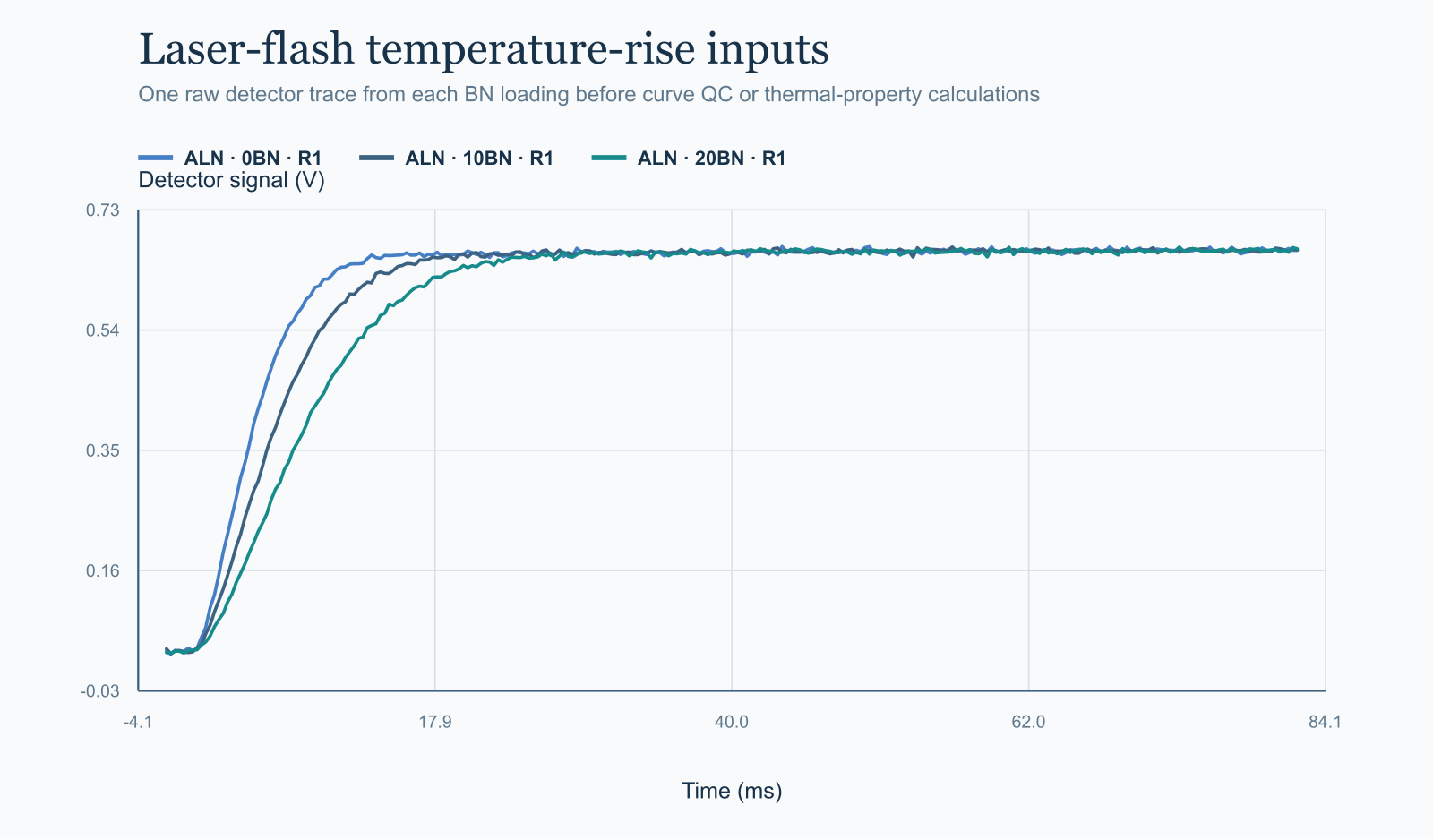
Shuffled detector points keyed by run, sample, point index, and time.
BN loading, replicate number, thickness, density, heat capacity, temperature, and coating status.
Declared processing and summary conventions needed for a reproducible handoff.
Rise timing, amplitude, and tail behavior must support QC decisions; run names do not reveal anomalies.
Group every detector point by run and sort the shuffled records by their stable point index.
Estimate baseline and rise characteristics, then record transparent reasons for accepting or rejecting each run.
Combine accepted timing metrics with thickness, density, and heat capacity while retaining units and run provenance.
Ensure processed points, run-level results, sample statistics, figures, and report use the same accepted-run set.